
H-05 · Skyscraper facade-cleaning concept
H-05 / CONCEPT
Lingchuang
Dedicated high-rise glass facade cleaning robot
A machine that brushes and squeegees the glass, with clear paths for suspension, fall protection and services. Lingchuang combines a flat octagonal frame, four vacuum zones and twin belts for skyscraper facades. Working line, fall-arrest line and service umbilical connect separately to roof equipment in this supervised original concept.
Original concept · AI-assisted artwork
Explore the concept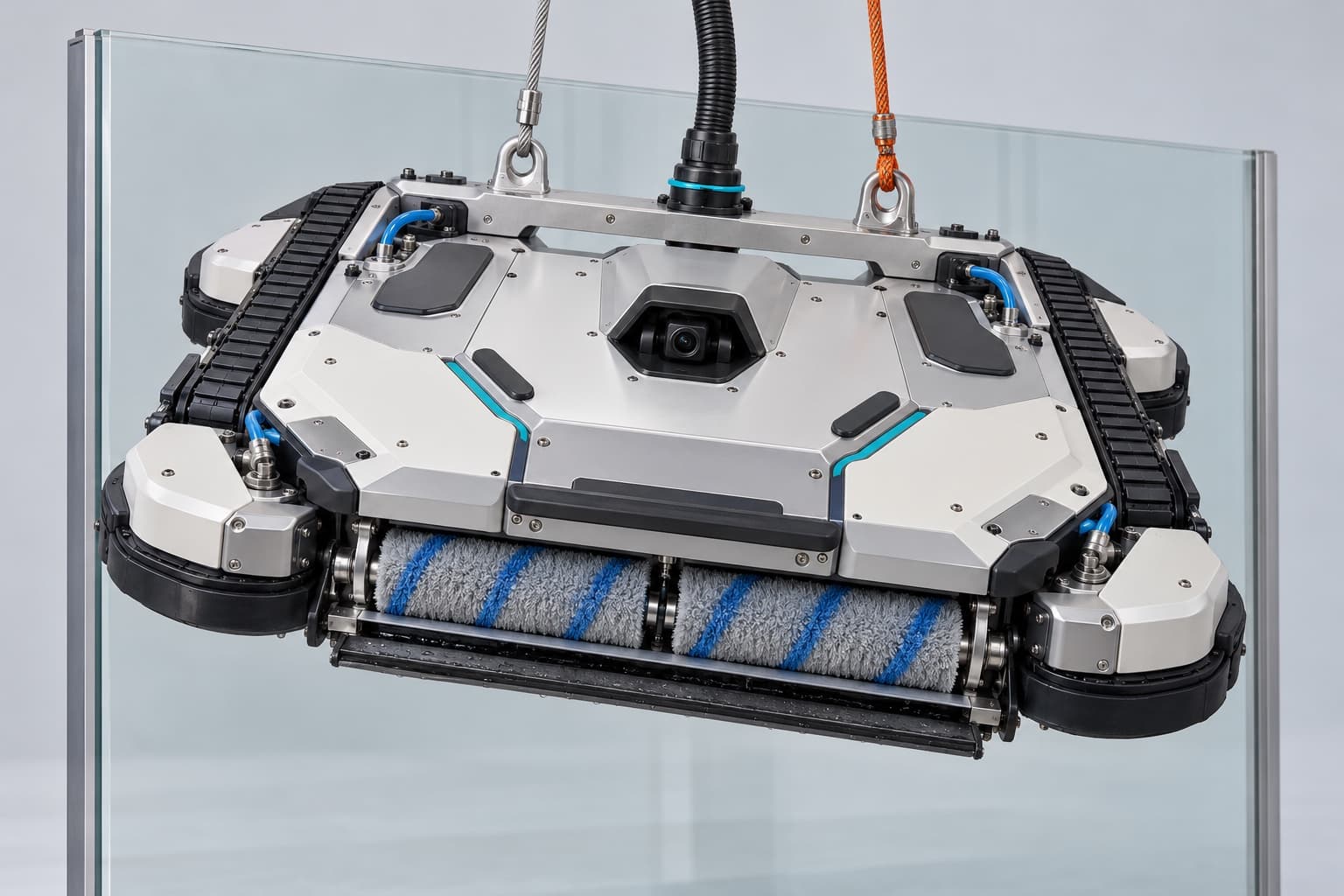
01 / In use
Controlled cleaning, one glass bay high above the city
Imagine routine maintenance of a CBD office tower. After checking the facade, weather, anchors and ground exclusion zone, the building team lowers Lingchuang over an approved flat glass bay. Roof equipment provides suspension, electricity and water; the machine stabilizes contact, scrubs and recovers wastewater under human supervision.
- 01
Confirm the building and work zone
Professionals assess glass coatings, joints, obstructions, roof anchors and rigging, then define weather conditions, the ground exclusion zone and retrieval route. Deep frames, damaged glass, curves and uncontrolled airflow are not assumed to be within this proposal’s scope.
- 02
Suspend, tether and establish contact
A roof hoist lowers the machine under control, an independent fall-arrest system remains attached, and a service reel manages the umbilical. Belt adjustment and cleaning are permitted only when vacuum and tension satisfy validated thresholds. Personnel can take over.
- 03
Brush, recover and confirm each move
Paired rollers and the trailing recovery channel treat the current bay, with visual cues for missed areas. Brushes stop near joints while the operator confirms the next move. The machine is retrieved for inspection afterward. Recovery rate, cleaning quality and speed require prototype tests.
02 / Form & mechanics
Form follows glass contact and rooftop coordination
01–06 cover suspension, services, zoned suction, belts and frame, cleaning/recovery, and the camera gimbal. Materials, dimensions and motor allocations are proposed selections. The complete exterior depicts one consistent machine.
- 01
Load beam and independent twin tethers
An aluminum load beam carries separate connections: a silver working suspension line to a rooftop hoist and an orange fall-arrest line to an independent roof anchorage and arrest device. Roof equipment supports suspension and controlled retrieval; suction stabilizes wall contact. Rigging, structural loads, brakes and anchors require building-specific professional validation.
- 02
Separate service umbilical and sealed manifold
The thick central black umbilical proposes separate electrical, clean-water and wastewater-return paths with strain relief and a sealed manifold. It is separate from both working and fall-arrest lines and provides no fall protection. Roof equipment supplies normal cleaning power and water; a reel manages slack to limit pulling on the machine.
- 03
Four vacuum zones and replaceable skirts
Four corner vacuum chambers propose flexible rubber skirts, check valves and individual pressure sensing, with one pump motor per zone, 4 total. Metal covers protect the air paths; skirt suitability must be tested on the specific glass. A zone leak would trigger a cleaning stop and controlled retrieval. Zone count does not replace fall protection.
- 04
Twin belts and a flat octagonal frame
One geared motor per narrow rubber belt proposes 2 drives for guidance and small adjustments on validated flat glass, coordinated with rooftop hoisting for suspended travel. A low-profile rounded-octagonal aluminum frame carries removable pale covers and elastomer bumpers. Its shape proves no ability to cross deep joints, projections or building corners.
- 05
Twin rollers, squeegee and liquid recovery
Two adjacent lower microfiber rollers propose one motor each, 2 total. A single lift-actuator motor positions the trailing squeegee, and a recovery channel routes wastewater toward the umbilical. One onboard dosing-pump motor complements the rooftop water and recovery plant. Brush pressure, sealing, water use and coating compatibility need testing.
- 06
Protected camera gimbal and inspection covers
The central dark window houses one two-axis camera gimbal, proposing one pan and one tilt motor, 2 total, for dirt, glass-edge and obstacle cues. Silver-white panels have removable inspection covers and compliant contact edges. The camera alone provides no vacuum, tether or fall-arrest protection.
03 / Internal systems & control
Open the body. Follow air, control and backup power.
One integrated exploded cutaway lifts the shell to expose compute, real-time control, backup energy, zoned air paths and service-power distribution. A lower-right section shows skirt and frame layers, with wet paths and electronics considered separately.
This is a design proposal with no high-rise operating certification, whole-machine trials or claim of suitability for every facade. Glass, coatings, joints, wind, anchors, rigging, supply and recovery conditions require building-specific assessment. People remain responsible for work authorization and takeover.
- A
Vision compute: candidate Jetson Orin Nano
The left heatsink-equipped board proposes an NVIDIA Jetson Orin Nano 8GB and carrier for camera feeds, dirt segmentation and work records. Official module modes span 7–25 W; integration must select a mode and validate cooling. This is not whole-machine power and proves no facade recognition or unattended-operation capability.
- B
Real-time control: STM32H753 and interlocks
The separate central board proposes an STM32H753, officially a Cortex-M7 microcontroller rated up to 480 MHz. It would gather four-zone pressure, belt encoders, IMU, umbilical status and tether tension, checking motion permissions before drives close their loops. A general-purpose MCU is not a certified safety controller; the protection chain needs separate design and validation.
- C
16S LFP backup and battery management
The removable right tray proposes a custom 16-series LFP pack: assumed nominal cells of 3.2 V and 10 Ah give 51.2 V, 10 Ah and 512 Wh. Candidate TI BQ76952 supports monitoring/protection for 3–16 series cells including LFP, alongside temperature probes, fusing and insulated busbars. Cells are unselected and illustrated schematically; capacity, discharge ability and switchover need tests.
- D
Zoned pneumatics, drives and wet-path isolation
Corner vacuum pumps, short blue tubes and pressure ports serve individual suction zones; belts and rollers use separate geared drives. The front recovery channel, dosing pump and squeegee actuator form a wet zone with protected electronics and harnesses elsewhere. The lower-right cut section illustrates the skirt and layered frame. Sealing, contamination, blockage and maintenance require tests.
- E
Service input, power tiers and recovery supply
The upper manifold separates electricity, clean water and wastewater. Fuses, contactors, DC/DC stages and backup switching feed drives and boards separately. The proposed exception response stops brushes and travel while preserving needed vacuum and communications for controlled retrieval by independent roof equipment. Cutting all power is not a safe-stop strategy by itself; roof emergency retrieval and combined power faults require joint validation.
Rooftop supply for work. Battery reserve for exceptions.
512
Wh · nominal onboard backup energy
- Normal work supply
- Rooftop power / water / recovery
- Custom pack proposal
- 16S LFP · 51.2 V · 10 Ah
- Onboard battery role
- Essential vacuum, control and communications
- Rooftop retrieval
- Independent support, braking and emergency plan
Nominal energy = 16 × 3.2 V × 10 Ah = 512 Wh
512 Wh is nominal energy calculated from proposed parameters, not cleaning runtime. Normal operation uses rooftop electricity and plumbing. On a fault, brushes and travel would stop while backup power supports necessary vacuum, control and communications for rooftop retrieval. Usable energy, pump demand, losses, temperature, switchover and retrieval height are unvalidated, so no fixed backup duration or cleaning-hour figure is provided.
Human authorization. Layered motion checks.
Vision compute suggests zones and actions; real-time control checks contact, tension and supply. A separate protection chain and roof equipment coordinate pauses and retrieval. Autonomy is limited to bounded actions within a confirmed work bay.
- 01
An operator confirms each bay and route
Personnel approve site conditions, start/stop and bay transitions. Vision assists with edges, dirt and obstructions. It does not authorize crossing joints, rounding corners or continuing in changing weather. Remote and on-site takeover arrangements must be agreed in advance.
- 02
Check vacuum and tension before execution
Real-time control gathers four-zone pressure, belt encoders, attitude, tension and service status to coordinate belts, pumps, rollers and the roof hoist. Drives close their loops on bounded targets. Thresholds, response times and sensor-fault detection need testing.
- 03
Preserve contact and retrieve on exceptions
On communication loss, supply faults, pressure loss or abnormal tension, the proposed response stops cleaning and travel, preserves necessary vacuum and communications, and requests rooftop retrieval. Independent fall arrest does not rely on vision. Personnel inspect and reauthorize after clearing the fault. Combined-failure behavior remains unvalidated.
YOUR NEXT IDEA
Make your high-rise maintenance idea specific
Begin with glass contact, rooftop coordination and human roles, then develop cleaning, control and recovery.
Start from this ideaTransfers an editable text brief. No automatic saving or image generation.