
H-04 · Firefighting and assisted-rescue concept
H-04 / CONCEPT
Lihuo
Large tracked firefighting and rescue robot
A broad tracked platform carries a water monitor and a low rescue tray so an operator can observe and direct water remotely, then assist transfer under rescue personnel’s supervision. Lihuo is an original proposal for a large non-humanoid machine, with clear roles for water supply, load support and human takeover.
Original concept · AI-assisted artwork
Explore the concept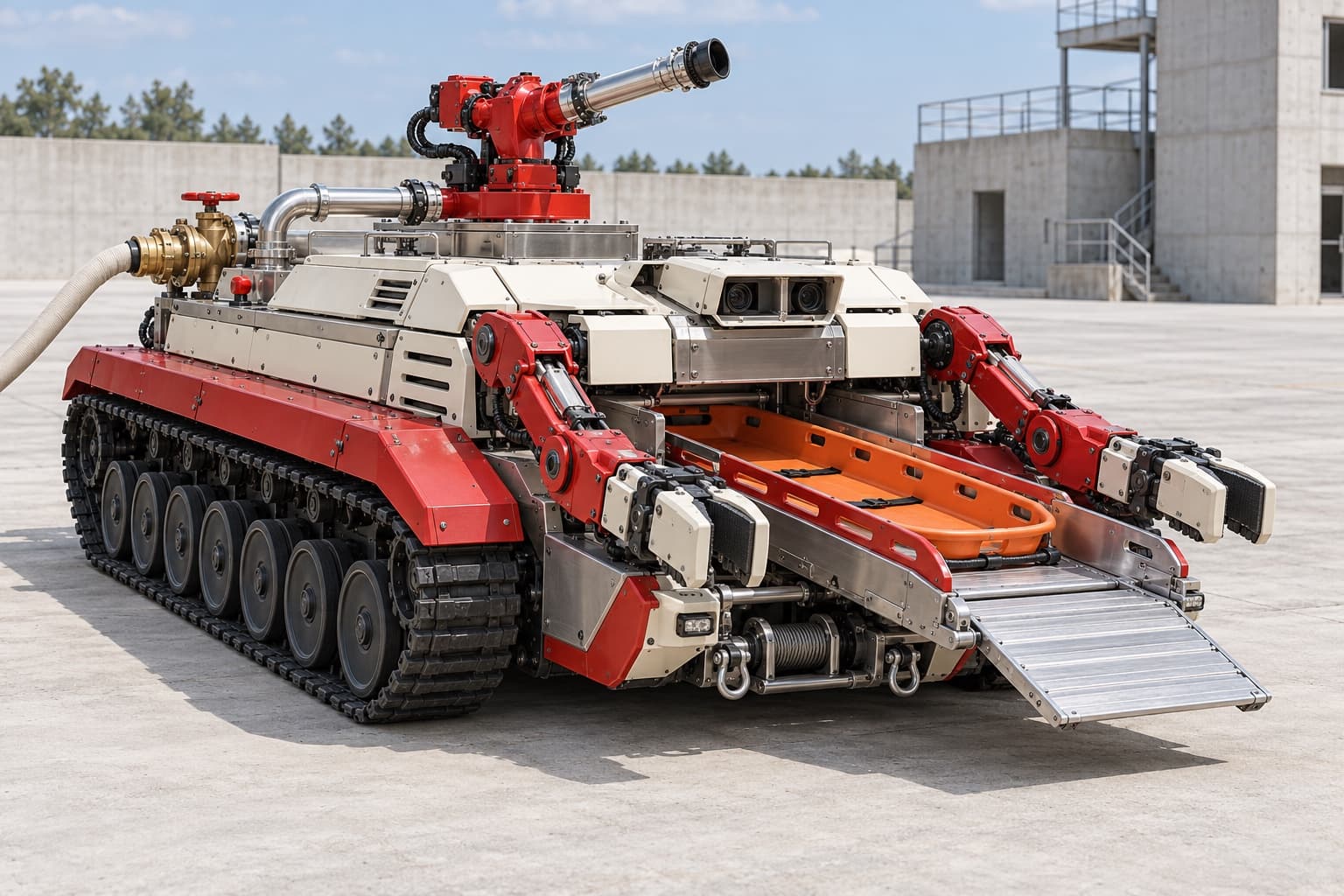
01 / In use
Direct water remotely. Bring a low transfer platform closer.
Imagine a warehouse fire: a fire engine supplies Lihuo through a hose while an operator controls the monitor from outside. Once rescue personnel assess the route and transfer conditions, the low tray would help move a secured person. Entry, withdrawal and rescue methods remain decisions for personnel on scene.
- 01
01 · Observe and authorize the task
Personnel review video, thermal imagery and environmental information, then confirm the route, supply and takeover arrangements. The operator decides monitor actions and whether to approach; the system provides sensing cues.
- 02
02 · Supply externally, operate remotely
The fire engine or external system provides the main water supply and pressure. The robot serves as a mobile monitor platform whose aim and flow are directed by the operator. Hose drag, reaction forces and communication remain constraints to validate.
- 03
03 · Support low, transfer under supervision
Rescue personnel transfer and secure the person. The low tray would provide a support surface for controlled movement, while arms assist tools and tray alignment. Unsuitable routes, loads or patient conditions cannot be overridden by a concept illustration.
02 / Form & mechanics
Form follows supply, load support and rescue tools
01–06 follow the visible monitor, plumbing, layered shell, arms, grippers, tracks and tray. Materials, mechanisms and counts are candidate selections. No whole machine or firefighting performance has been validated.
- 01
External supply and remote water monitor
Stainless plumbing connects the rear-side brass hose inlet to the upper monitor. Water and the main pump come from a fire engine or external supply. One pan and one tilt motor are proposed. Flow, pressure, reaction force and hose drag require joint validation; no firefighting range is claimed.
- 02
Layered shell and protected sensing windows
A steel frame would carry replaceable stainless shields, insulation and air gaps beneath ivory and fire-red covers. Front visual/thermal windows and internal temperature sensing support operator awareness. Materials, sealing, window contamination and thermal management need testing; the shell does not imply unlimited fire exposure.
- 03
Low paired arms and joint shields
Short steel/aluminum links use metal joint covers. Three powered axes per arm propose 6 motors for light-obstacle handling, tool positioning and tray alignment. Payload, force limits, reach and stability need prototype validation. Directly lifting a person with the arms is not assumed.
- 04
Broad grippers and replaceable contact pads
Linked metal two-jaw grippers propose one motor each, 2 total, with task-specific replaceable contact pads. They assist with tools and graspable objects rather than contacting a casualty. Pad temperature suitability and gripping force need validation.
- 05
Wide tracks and a low chassis
One motor and reduction final drive per metal track propose 2 drive motors, with road wheels and replaceable contact blocks. Low battery placement and a wide stance support load layout. Clearance, turning, slopes, steps and stability under monitor reaction require tests; track appearance alone proves no obstacle capability.
- 06
Low stretcher tray and front winch
A stainless telescoping tray carries a removable orange rescue sled, side rails, restraints, a manually folded ramp and passive support rollers. One tray-extension motor and one front winch propose 2 motors. Rescue personnel assess, transfer and secure the person. Tray loading and winch use require dedicated validation.
03 / Internal systems & control
Open the shell. Follow energy and control.
One integrated exploded cutaway reveals protected compute, real-time control, a low battery, representative transmissions and power distribution. The large fire-water path and electronics cooling loop are separate.
This entire case is a concept proposal. It has no firefighting or explosion-protection certification, and no validated fire temperature, exposure time, payload, monitor range or rescue performance. Trained personnel on scene decide actual fire rescue actions.
- A
Perception compute: candidate Jetson Orin NX
A candidate NVIDIA Jetson Orin NX 16GB and carrier would sit in a protected compute enclosure, combining visual/thermal feeds, obstacle cues and teleoperation video for the operator. A 25 W module mode is an integration starting point with a cold plate and heat spreader. Module power is not whole-robot power, and fire-scene perception is unvalidated.
- B
Real-time execution: STM32H743 and feedback
A candidate STM32H743 board would collect encoders, IMU, tray position, water-supply status and temperature signals, coordinating drives over interfaces such as FD-CAN. Drivers close the velocity/position loops on bounded targets. AI cues and video do not directly provide stop protection; the MCU is not itself a certified safety controller.
- C
Low-mounted 30S LFP pack and BMS
Using the official LF150 figures of 3.22 V and 150 Ah as a candidate baseline gives 30 series cells, 96.6 V, 150 Ah and 14.49 kWh nominal energy. A low bay would contain compression framing, BMS, temperature probes and insulated busbars. No pack has been procured; full voltage range, current, mass, cooling and thermal isolation need design validation.
- D
Motors, reduction and load holding
Representative track and arm drives separate into motors, reducers, bearings, encoders and braking/holding mechanisms selected for their loads. The 14 mechanism drives are not identical motors all running at full power. Peak current and thermal load across tracks, grippers, monitor and tray require combined-duty analysis.
- E
Power, temperature sensing and a separate stop chain
Fuses, a main contactor and distribution would feed drives rated for the full 30S voltage range; DC/DC converters supply boards and sensors. A separate stop chain receives human stop inputs, accounting for load support and braking. Cold-plate cooling is separate from fire water. Internal heat, smoke/water ingress and communication-loss behavior require tests; no fire temperature or exposure time is specified.
How might platform operating time be estimated?
2.3–3.9
hours · theoretical non-fire duty
- Candidate battery
- 30S LFP · 96.6 V · 150 Ah
- Nominal energy
- 14.49 kWh
- At 80% usable energy
- 11.592 kWh
- Assumed battery-side average
- 3–5 kW
Time ≈ 14.49 kWh × 80% ÷ 3–5 kW ≈ 2.3–3.9 h
Assumes a combined 3–5 kW average for travel, intermittent mechanism motion, compute, sensing, cooling and conversion losses in non-fire conditions. No test has been performed; peak power is separate. The external fire engine/supply pump draws no power from this robot battery and is excluded from the formula. Water-supply duration is not battery runtime. Load, slopes, hose drag, heat and duty cycle change the result; thermal limits may arrive before energy limits.
Operator direction. Layered execution.
Lihuo is proposed primarily for teleoperation: AI combines visual/thermal information and obstacle cues, a real-time controller coordinates mechanisms, and a separate protection chain handles validated stop conditions. The concept grants no authority to decide fire rescue autonomously.
- 01
People select tasks and monitor actions
Under incident command, the operator chooses routes, aiming and water actions. Rescue personnel assess the person and complete transfer and securing. Recognition output is supporting information; it cannot independently authorize entry or handling a person.
- 02
Controllers check and execute targets
Compute provides video and bounded targets. Real-time control checks positions, supply and temperature states before drivers close their loops. Interlocks across tray, arms and tracks, plus human takeover, need prototype validation.
- 03
Pause on exceptions; confirm recovery
Remote stop and physical buttons would feed a separate stop chain, accounting for track braking and tray support. Communication loss, supply faults, internal heat and withdrawal behavior require dedicated validation. Personnel clear the exception and confirm before resuming.
YOUR NEXT IDEA
Make your rescue robot idea more concrete
Begin with its task, platform scale and human responsibilities, then develop the form, energy and mechanisms.
Start from this ideaTransfers an editable text brief. No automatic saving or image generation.