
H-03 · Future companion concept
H-03 / CONCEPT
A little companion, at your request.
V-Bee
A palm-sized V-shaped assistant imagined to accompany, remind and guide with your permission. Its propeller-free hovering depends on a future core with no engineering implementation. This original design separates real electronics candidates from the fictional hover mechanism.
Original concept · AI-assisted artwork
Explore the concept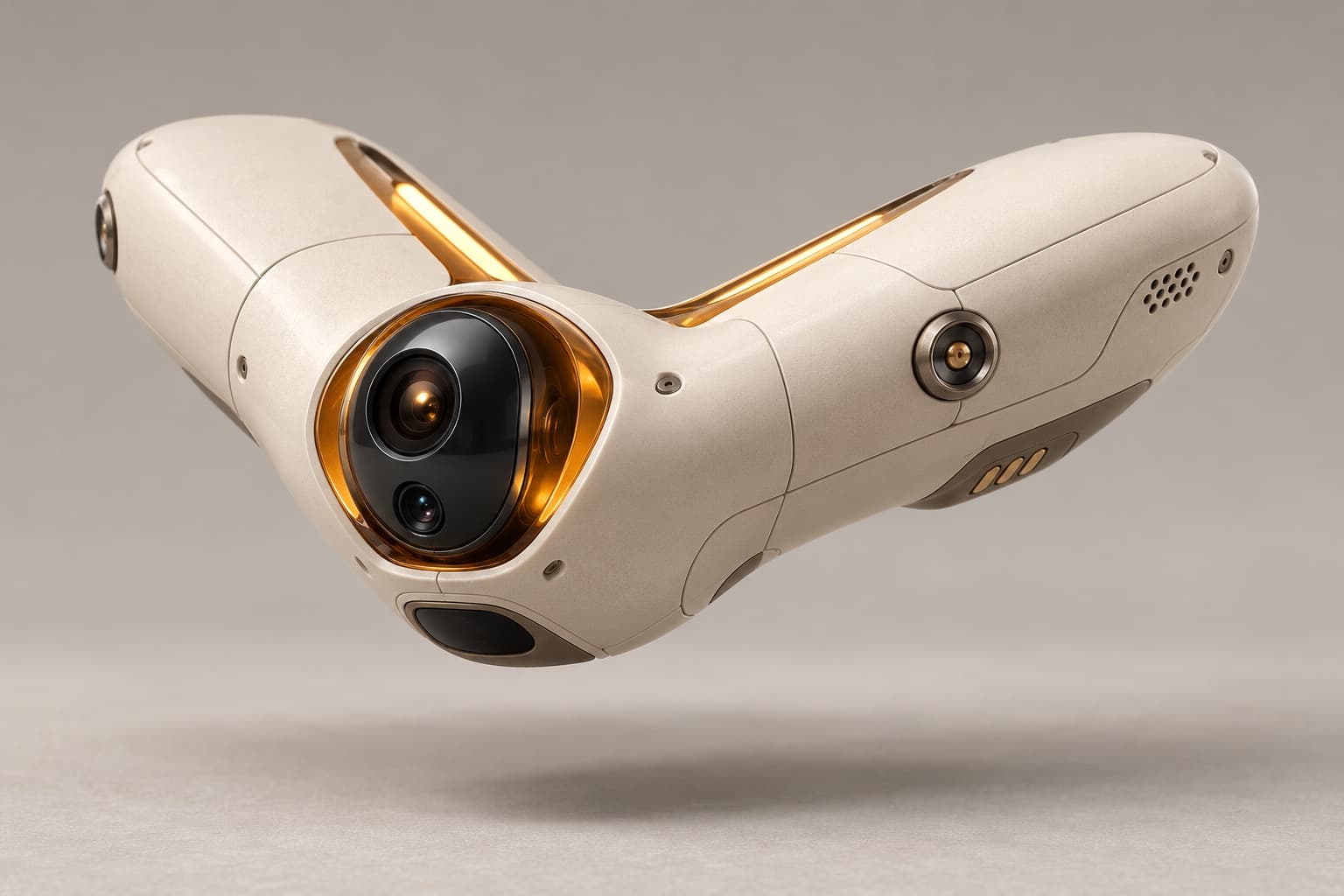
01 / In use
One timely reminder in an unfamiliar conservatory
A visitor wants to reach a booked tour while exploring at her own pace. V-Bee is imagined to use an authorized booking and venue route, offering brief prompts at junctions. The person always decides whether to continue.
- 01
Authorize one task
The visitor selects a downloaded venue route and booking reminder on her phone, separately approving camera use. Continuous audio or video recording is not the default.
- 02
Offer a brief prompt
The concept would accompany within authorized areas and agreed spacing, using light patterns, short sounds and phone prompts near a junction or appointment. It would not make the final direction choice for the person.
- 03
Pause or end at any time
Pause and end controls stay visible on the phone. The visitor can disable sensing or cancel. A future flying version would first need validated controlled stopping, landing and retrieval; sudden power loss is not a solution.
02 / Form & mechanics
One V silhouette. Six visible functions.
A shallow V surrounds optics, status prompts, ranging and docking contacts. Micro nozzles express an attitude concept only. Callouts 01–06 match the final image; mechanism counts follow the proposal below.
- 01
Palm-sized V shell
A proposed 140 mm span gives the rounded shoulders a shallow V silhouette. Ivory PC/ABS covers and amber light guides would surround a light metal mounting frame. The bee reference describes its companion character, not literal bee dimensions. Size and materials are proposals.
- 02
Dual optics and two-axis gimbal
A dark front window combines a main camera and secondary sensing optic in an amber cradle. Two proposed micro servos adjust pan and tilt only; they provide no lift. Optics, field of view and obstacle perception require validation.
- 03
Downward ranging window
A separate dark window below the nose would house a downward ToF sensor to assist with ground-distance and docking observations. Single-point ranging does not replace environmental perception; glass, reflective surfaces and strong light need specific evaluation.
- 04
Cold-gas attitude nozzle locations
Small metal ferrules indicate a four-channel cold-gas attitude concept, partly visible on the near and far sides. They are neither propellers nor hidden fans and are not assigned weight-supporting lift. Pressure, thrust, gas capacity and full attitude controllability remain unvalidated.
- 05
Visible status and prompts
Amber light guides inside the V would use distinct pulse patterns for waiting, confirmation and faults; side openings support brief audio prompts. Camera use requires a visible indication and a privacy switch on the paired device. Color alone would not carry critical status.
- 06
Dock contacts and service seams
Gold contacts along the lower edge would meet a fixed charging dock; service seams allow access to electronics. Charging requires confirmed physical support and contact state. The floating image expresses a future idea, not demonstrated autonomous landing or docking.
03 / Internal systems & control
Open the body. Separate electronics from speculation.
One integrated exploded cutaway reveals the logic board, battery, gimbal and gas lines. Central cartridge C is explicitly fictional. Real parts are electronics-study candidates, not evidence that the whole robot can be manufactured, flown or tested.
The hover core has no verifiable engineering solution. No whole robot has been built or tested for lift, noise, companion-flight safety or flight endurance. The electronics bench study and future hover idea require separate reviews.
- A
Real electronics candidates: compute and control
Raspberry Pi Zero 2 W could evaluate basic vision and pairing: a 1 GHz quad-core Cortex-A53, 512 MB RAM and 65 × 30 mm board. A separate STM32H743-class MCU would read IMU/range states and command the gimbal and valves; a paired phone handles complex language. The artwork illustrates functions, not exact boards, and validates neither packaging, cooling nor flight control.
- B
Real electronics candidates: battery and protection
The electronics-demo budget assumes a 1S, 3.7 V, 1.2 Ah lithium-polymer pack: 4.44 Wh nominal. Separate pack protection covers overcharge, overdischarge and overcurrent, with NTC temperature monitoring. TI BQ24074 is a candidate charger/power-path device, alongside voltage-matched boost/regulator rails. It does not replace pack protection, and this pack is not sized for the fictional hover core.
- C
Fictional component: future hover core
The central amber annular cartridge is a visual placeholder for antigravity or future hovering technology. There is no verifiable purchasable engineering implementation and no prototype data for lift, power, noise or reliability. Its ring shape represents no solved physical mechanism. There are no exposed or hidden propellers; this concept does not enable a flyable product today.
- D
Attitude concept: reservoir, valves and lines
The right assembly illustrates a small reservoir, regulator, four proposed electrically controlled microvalves and metal capillaries leading to the nozzles. Cold-gas pulses suggest attitude correction only, not weight support. Valves and vessel are unselected; gas use, noise, thrust and human exposure are uncalculated. Valve counts are separate from gimbal motor counts.
- E
Real mechanism candidates: gimbal and optics
The left assembly opens the dual optics, two-axis brackets and flex cable. Two micro servos could be evaluated from the FEETECH FS0307 class, specified at 4.8–6 V and about 4.4 g; ST VL53L1X is a downward-ranging candidate. Payload, backlash, supply peaks and occlusion need measurement. Component specifications establish neither obstacle avoidance nor flight capability.
Electronics energy is not flight endurance
4.44
Wh · proposed electronics pack
- Assumed battery
- 1S · 3.7 V · 1.2 Ah
- At 80% usable energy
- About 3.55 Wh
- Assumed average electronics power
- 2.5–4.5 W
- Theoretical electronics-only bench time
- About 47–85 minutes
4.44 Wh × 80% ÷ 4.5–2.5 W ≈ 0.79–1.42 hours
Assumed battery-side power includes compute, sensing, radio, intermittent gimbal motion and conversion losses; it is unmeasured. Hover-core energy is unknown and the gas system is unsized. Both are excluded from this electronics budget, so it establishes no flight endurance, quietness or weight-supporting capacity.
You authorize. Then it begins.
These are future interaction and control goals. Reminder, privacy and gimbal behavior can first be studied on a mechanically supported electronics bench. An existing flight controller is not claimed.
- 01
Autonomy on request
Accept only routes and reminders confirmed by the paired user. Camera activation, saving and uploading need separate permission. Continuous audiovisual storage is off by default; a paired phone handles complex language.
- 02
Return uncertainty to the person
The user can take over the gimbal, cancel or disable sensing from the phone. Identity errors, occlusion, link loss or uncertain perception end guidance. Independent control logic must constrain motion; a language model must not command valves directly.
- 03
Controlled stop and recovery
A future version needs stop and retrieval strategies based on battery, gas pressure, communication and core state; abrupt power loss is not a safe airborne stop. Landing and takeover strategies remain unvalidated until hover technology exists. A person confirms task recovery.
YOUR NEXT IDEA
When should your companion speak up?
Use this concept to rewrite its setting, prompt style and privacy boundaries. Hover technology remains a separate unsolved requirement.
Start from this ideaTransfers an editable text brief. No automatic saving or image generation.