
EMBODIED CONCEPTS / 02
H–02 / COEXIST
Ready to help. Willing to give way.
H-02 Coexist · Greenhouse collaboration robot
Two arms, four short wheel-legs and a height-adjustable sensing head. A body shaped around collaboration, with clear, considerate behavior in human workspaces and natural surroundings.
Original Jichuang concept · AI-assisted imagery
Explore the concept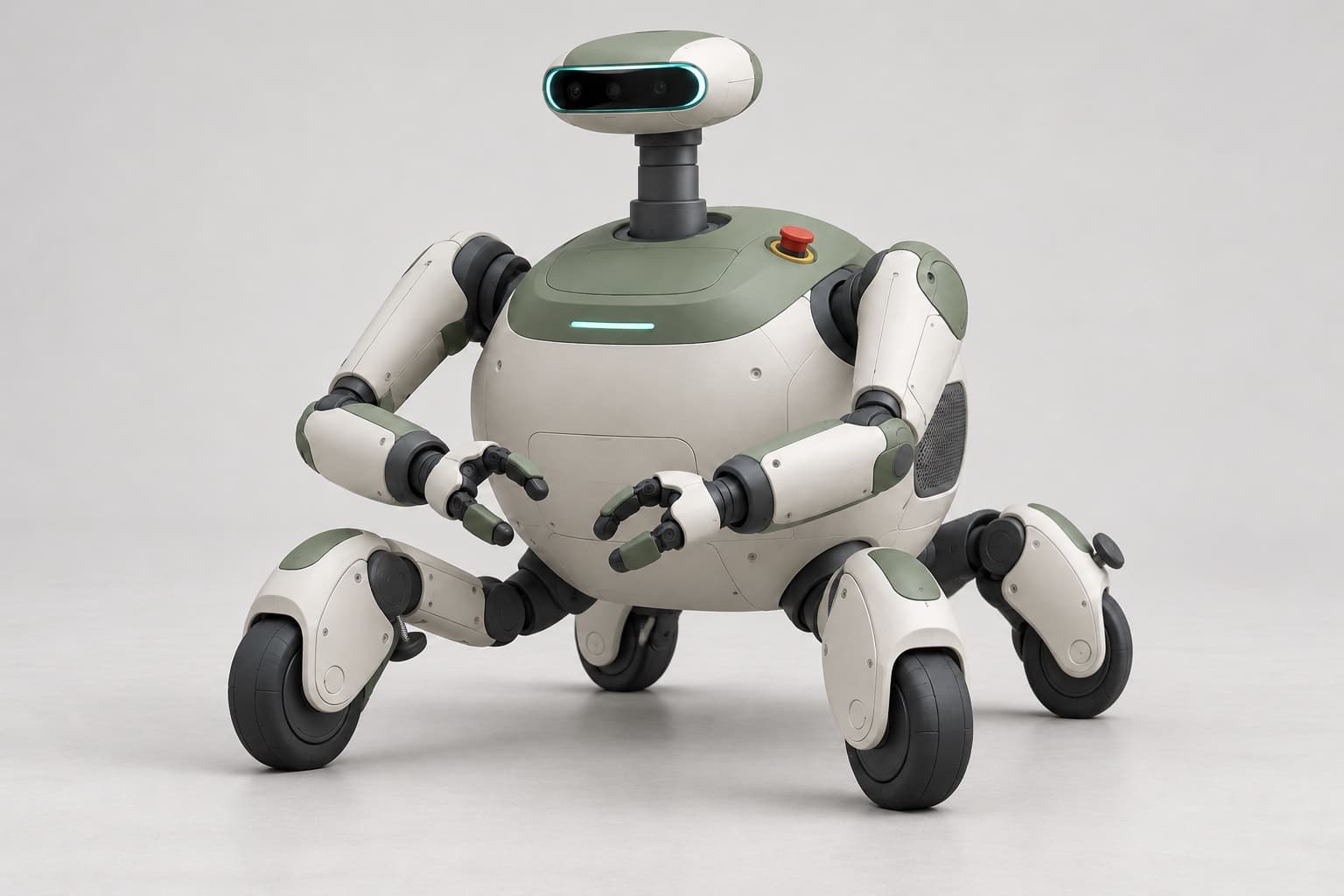
01 / Scenario
One tray of seedlings. A considered handoff.
Imagine a community greenhouse: Coexist reaches a planting bench along a paved aisle, parks and deploys its support pads, adjusts its viewing height, and shares the seedling tray with a gardener. One handoff explains how the arms, low base and stationary supports work together.
- 01
Confirm the task and route
A gardener selects a configured tray-handoff task and confirms the receiving point. The robot would observe the aisle, people and obstacles.
- 02
Park and share the tray
Stop rolling and deploy the pads. Adjust the arms and sensing height, then hand over the tray after mutual confirmation.
- 03
Fold, yield and return
Confirm that the tray has been received, fold the arms and retract the pads. Leave along the aisle, pausing to give people or animals room.
Coexistence takes shape in everyday actions
Make actions understandable
Show work status and observation direction clearly. Allow confirmation before approaching, handing over objects or resuming a task.
Leave room for the surroundings
Use existing paved routes, yield to people and animals, and aim to reduce pressure on vegetation and disturbance to habitats.
Plan for repair
Propose replaceable covers, contact pads and wheel modules. Return to a fixed charging point and make maintenance part of everyday use.
02 / Form and mechanics
A rounded form. A clear mechanical role.
Start with covers, frames and contact surfaces, then follow the proposed drive allocation across arms, wheels, supports and the sensing head.
- 01
Adjustable sensing head and window
Off-white PC/ABS covers and a dark polycarbonate window retain a horizontal sensing profile. One lift and two pan/tilt drives propose 3 motors to adjust the viewing height and direction.
- 02
Arms and joint covers
Segmented PC/ABS covers enclose aluminum links. Each arm proposes 3 shoulder, 1 elbow and 2 wrist axes: 12 motors total. Folding the arms would reduce the space occupied in an aisle.
- 03
Coupled grippers and contact pads
Aluminum fingers carry replaceable TPU or silicone contact pads. A linkage couples the three-finger silhouette. One gripping motor per hand proposes 2 total; independent dexterous finger control is not assumed.
- 04
Rounded covers and load-bearing frame
Removable moss-green and off-white covers enclose an aluminum frame with rounded edges. Side access supports cooling and service; a visible stop button sits on top. Materials, sealing and weather resistance require prototype validation.
- 05
Four driven and steerable wheels
Metal wheel carriers use replaceable rubber tires. One rolling and one steering motor per wheel propose 8 total. Tires contact the ground during travel, with support pads retracted. Existing paved aisles are the default route.
- 06
Leveling wheel-legs and stationary pads
One leveling arm drive and one support-screw drive per corner propose 8 motors. Metal pads use rubber contact surfaces. Pads support stationary work and retract before travel; all-terrain legged locomotion is not implied.
03 / Systems and control
One image. Perception, energy and control.
An integrated exploded cutaway opens the rounded body and low base, connecting compute, real-time control, battery, drives and power distribution.
The hardware, mechanisms and control modes below are candidates. Whole-robot construction, energy use and safety have not been validated.
- A
AI compute and visual perception
A candidate Jetson Orin NX 16GB module and carrier, depth cameras, heat sink and fan would support tray recognition, people/obstacle perception and authorized-task planning. Results depend on models, calibration and integration. Language understanding is not a safety controller.
- B
Real-time control and motion feedback
Candidate STM32H7-class boards collect wheel speed, encoders, IMU and support-position states, coordinating distributed drivers over a communication bus. Drivers handle current/position loops. The AI computer supplies bounded targets; interlocks and the stop chain require separate design.
- C
Low-mounted LFP pack and BMS
Proposed evaluation baseline: an 8-series LFP pack, 25.6 V, 30 Ah and 768 Wh, mounted low in the base. The BMS monitors cells, balances them and manages protection. Pack mass, size, available current and greenhouse suitability require selection; charging would use a fixed dock.
- D
Drivers, motors and reduction stages
Representative wheel and arm drives separate into motors, reducers and encoders. Rolling/steering, leveling/support and arm actuators need different duty ratings. A 33-motor allocation does not mean all motors run at the same power simultaneously.
- E
Power conversion and the stop chain
Fuses, contactors and distribution feed drives selected for the full 8S voltage range. DC/DC converters supply compute and sensors. A separate stop chain receives the stop button; stopping must account for load support and braking rather than assuming abrupt whole-robot power loss is safe.
How long might one charge support collaboration?
1.8–3.1
hours · estimated duty scenario
- 8S lithium iron phosphate
- 25.6 V / 30 Ah
- Nominal energy
- 768 Wh
- At 80% usable energy
- 614.4 Wh
- Assumed whole-robot average power
- 200–350 W
Runtime ≈ nominal energy × usable fraction ÷ average whole-robot power
614.4 Wh ÷ 350 W ≈ 1.8 h · 614.4 Wh ÷ 200 W ≈ 3.1 h
Assumes a 200–350 W whole-robot average at the battery, including compute, sensing, motion and conversion losses. No energy-use test has been performed. This is not peak power; tray load, routes, leveling, supports, temperature and idle time change the result.
Human authorization. Autonomy within a defined task.
Coexist would execute configured greenhouse routes and handoffs. A person selects the task; perception and planning supply bounded targets, while real-time control and protection determine execution conditions.
- 01
Automatic execution
A person selects and confirms a handoff task. The system would recognize the aisle and tray and follow a configured route. Arm handoff is allowed only after parking and support deployment are confirmed.
- 02
Human takeover
Teleoperation or teaching supports setup and exceptions. Uncertain perception, an occupied aisle or an unconfirmed handoff calls for a pause. A prediction does not authorize further movement.
- 03
Stop and recovery
The red button and remote stop would feed a separate stop chain that considers wheel braking and support for held objects. After an obstruction is cleared, a person checks and confirms recovery. Protection functions require dedicated validation.
YOUR NEXT IDEA
Bring Coexist into your setting.
Change the purpose, appearance and components to create a robot concept for the environment around you.
Start from this ideaTransfers editable text only. You decide whether to save or generate.